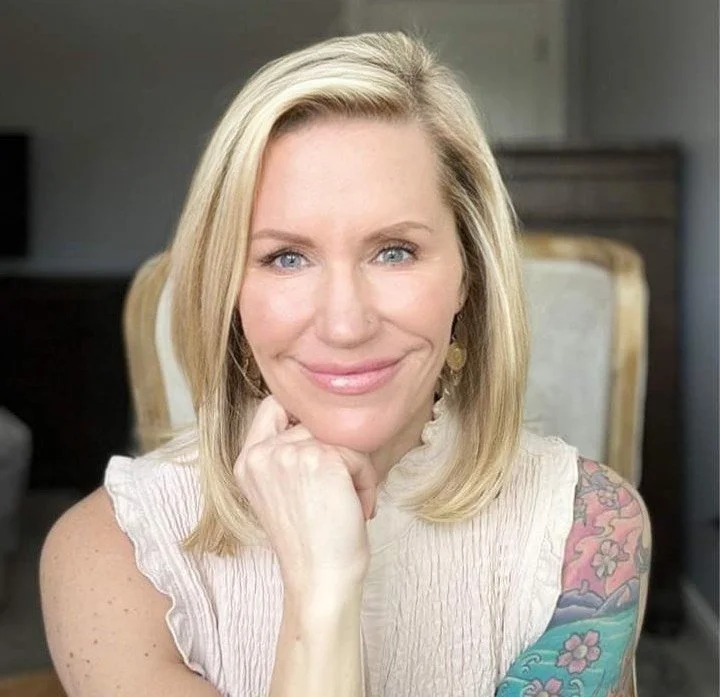
I grew up in an alcoholic home. Drinking wasn't something I discovered — it was just always there. What I didn't fully understand until much later was that it wasn't just my home. My grandmother died of alcoholism too. Nobody talked about it. It was one of those family truths that lived in the walls but never got spoken out loud — and that silence was its own kind of inheritance.
I had my first drink at 14, and from that very first sip, alcohol and I had a love story. I romanticized it completely. It felt like mine.
The red flags came early. I was arrested at 16. By 18, blacking out was routine. I did a brief stint of outpatient treatment at 19, found some footing through AA, and stopped for a while. But by 21, I was back to it — and looking back, those early years were screaming at me. The arrest, the blackouts, the treatment at 19 — all of it was trying to tell me something.
I tried geography instead. Los Angeles. Chicago. Indiana. New city, fresh start, different version of myself. But wherever I went, there I was — and so was the desire to drink, to escape, to take the edge off whatever the new place brought with it. You cannot outrun something that lives inside you. Every move just gave it a new backdrop.
And alcohol wasn't traveling alone. Money became its own addiction alongside it — spending as a way to feel something, to reward myself, to fill whatever was hollow. But it didn't stop there. I would self-sabotage in ways I couldn't fully explain at the time. Opportunities I let slip. Financial stability I quietly dismantled, almost as if some part of me didn't believe I deserved to hold it together. The drinking and the spending and the sabotage were all speaking the same language — I just didn't have the ears to hear it yet.
"Alcohol was never just alcohol. It was the whole ecosystem built around it — the spending, the escaping, the slow and silent self-destruction."
But then something insidious happened: the consequences stopped showing up — or so I told myself. For nearly two decades, I managed to escape serious external trouble. No more arrests. No public crashes. Nothing that forced anyone — including me — to say the quiet part out loud. And that silence became its own kind of trap.
"When nothing catastrophic happens, it's easy to convince yourself it isn't that bad. The absence of a rock bottom became my permission slip to keep going."
No one could tell me to stop. As far as I was concerned, I had it all under control. And the evidence seemed to back me up. I earned my Master's degree. I traveled. I built a career and held great jobs. I kept things together — seemingly well. I was functioning, achieving, moving forward. The two decades of smooth sailing held me captive to the belief that I was fine. That it wasn't that bad. That people with real problems looked different than me.
I watched my dad die of alcoholism at 65. The same disease that had taken my grandmother — the one no one ever talked about — was now taking him, right in front of me. And even that didn't stop me. That's how powerful this love story was. That's how deep the romanticization ran.
"Three generations. The same story. And still, I told myself I was different."
And then there was the moment with my daughter.
She was six years old. I asked her to go grab my wine off the kitchen counter and bring it to me. She did — sweet and obedient, the way little kids are. It was probably my third or fourth glass. I will never know how that moment felt inside of her. But I know from my own childhood exactly what it creates: an atmosphere of unsafety. A fear that a child can't name, can't explain, can't find the words for — but carries anyway.
And here's what I want to say plainly, because it doesn't get said enough: asking our children to fetch our drinks is something we gloss over. We treat it as harmless, even cute — a little errand, a small moment of helpfulness. We don't pause on it. We don't examine it. But a child who is recruited into serving a parent's drinking, however innocently, is being pulled into something they should never have to carry. It gets normalized so quietly that most people don't even register it as a moment worth examining. I'm registering it now.
"I had become the very thing I grew up in. And I still wasn't ready to see it."
There was no dramatic rock bottom. Just the exhausting weight of not being real — not with the people I loved, and not with myself. Wearing a mask everywhere I went. Leading a double life no one could fully see.
And then my son was born. Something shifted. In December 2020, at 43 years old, I stopped. For good this time.
Sobriety changed everything. Not all at once, and not without work — but everything.
Today I am someone completely different than the woman who was hiding. My mental capacity has opened up. I'm present — for my husband, for my children, for my own life. I do what I say I'm going to do. I walk away from people and things that don't feel aligned. I have boundaries, real ones, and I keep them.
"I am loyal to my own Soul now. And I am more deeply connected to God than I have ever been."
That's what freedom actually feels like. Not perfect — but honest. Whole. Mine.
I share my story because I know there are people out there who look fine on the outside and are falling apart on the inside. People who don't see themselves in the dramatic recovery stories — the high-achievers, the ones who "have it together," the ones nobody would ever suspect. Friends and family who love someone who is struggling and don't know how to help.
This is for all of you.
I write, create content, and work with people one-on-one to help them find their own version of this freedom. You don't have to have a rock bottom. You just have to be tired enough of the mask.